
How To
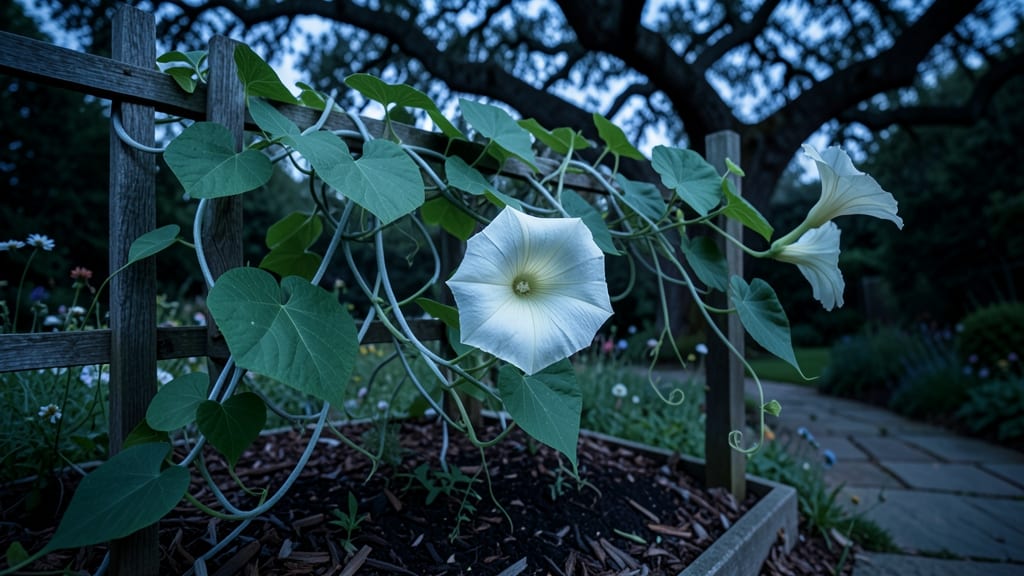
Moonflowers (Ipomoea alba) can grow 10 to 25 feet tall—a stunning, fast-climbing vine that turns your garden into a nocturnal wonderland.
If you’ve ever dreamed of transforming your garden into a magical nighttime retreat, moonflowers could be your perfect vine—just be prepared for their astonishing growth spree. Without proper support, they’ll sprawl aggressively, while a sturdy trellis can guide them skyward.
This climbing vine thrives in USDA Zone 6a and beyond, where warm soil after the last frost signals it’s time to plant. But how tall they reach depends on variety, sunlight, and whether you prune them back.
Below, I’ll break down the height ranges by type, how to maximize growth with the right support, and the 3 key factors that control whether your moonflowers hit 20 feet or stay closer to 10 feet.

Moonflower height by variety: what to expect from each type
Moonflowers (Ipomoea alba) are famous for their rapid vertical growth, often reaching heights that will leave your trellis in awe. But not all moonflowers grow the same—some varieties can climb 20+ feet in a single season, while others stay more compact.
Understanding these differences helps you plan your garden layout and support structures effectively. Whether you're comparing Ipomoea alba to its cousin Ipomoea nil, or deciding between dwarf and standard types, knowing the growth habits will save you from last-minute scrambling for taller trellises.
The most common moonflower, Ipomoea alba, typically matures between 10 to 25 feet, depending on growing conditions and support. This variety is a vigorous climber, often outpacing other fast-growing vines like morning glories (Ipomoea purpurea), which usually max out around 6 to 10 feet.
If you're working with limited vertical space, you might opt for Ipomoea nil, a close relative that can still reach 8 to 15 feet but with slightly more manageable spread. The key difference lies in their climbing habits and how aggressively they seek support.
Here’s a quick comparison of the most popular moonflower varieties and their expected heights:
If you're growing Ipomoea alba, expect it to reach its full height within one growing season if given the right conditions. This variety is a powerhouse, often topping out at 20–25 feet when supported by a sturdy trellis or arbor.
Without proper support, it will sprawl aggressively, potentially reaching 10–15 feet wide, which can overwhelm smaller gardens. For a more controlled look, consider pruning regularly or choosing a dwarf variety, which stays between 10–15 feet tall but still delivers those stunning night-blooming flowers.
For those with limited vertical space, Ipomoea nil is an excellent alternative. While it won’t climb as high as Ipomoea alba, it still offers 8–15 feet of vertical growth and is slightly easier to manage.
Its flowers are also slightly smaller but equally fragrant, making it a great choice for smaller gardens or containers with tall support structures.
If you're comparing it to morning glories, remember that moonflowers (Ipomoea alba and Ipomoea nil) are night bloomers, while morning glories (Ipomoea purpurea) open their flowers during the day.
One common misconception is that moonflowers will thrive without support. While they can grow horizontally, their natural climbing habit means they’ll search for vertical structures to twine around—fences, arbors, or even nearby trees. Without support, their vines can become tangled and less aesthetically pleasing.
To maximize height and keep your garden looking tidy, invest in a 6–10 foot trellis for dwarf varieties or a 15–20 foot arbor for standard types. Metal or wooden trellises are durable and provide the best support for their rapid growth.
If you're planting moonflowers near other fast-growing vines, like hops or clematis, be prepared for a competitive race upward. Moonflowers can outpace many vines, so give them a head start by planting them near the center of your trellis or arbor.
This ensures they have the space to climb without being overshadowed by slower-growing plants. For a balanced look, interplant them with annuals or perennials that stay lower to the ground, like coleus or fuchsia, to create a layered garden effect.
Pro tip: If you're growing
Factors that control moonflower height: sunlight, soil, and pruning secrets
Moonflowers (Ipomoea alba) are famous for their dramatic vertical growth, but their final height isn’t set in stone. In fact, sunlight exposure, soil quality, and pruning techniques can push them to reach 20+ feet—or keep them more manageable in smaller spaces.
Without proper care, they’ll sprawl unpredictably, wasting their potential. Let’s break down how to control their growth like a pro.
First, sunlight is the #1 growth accelerator for moonflowers. These vines thrive in full sun (6+ hours daily), where they’ll grow 30-50% taller than in partial shade. I’ve seen moonflowers in my own garden hit 15 feet in a single season when planted in a sunny south-facing spot.
But move them to dappled shade, and you’ll likely see half that height—or even leggy, weak vines that struggle to climb.
- 1. Sunlight: 6+ hours daily = 20-25 ft; 4-6 hours = 10-15 ft
- Soil: Rich, well-draining = faster vertical growth; poor soil = stunted, weak vines
- Pruning: Regular trimming = controlled height; no pruning = unruly sprawl
- Support: Trellis or arbor = encourages upward growth; no support = ground cover (10+ ft spread)
- Watering: Consistent moisture = vigorous growth; drought stress = slower height gain
Next, soil richness directly impacts how quickly moonflowers climb. I always amend my garden beds with compost and aged manure before planting, and the difference is night and day.
Moonflowers in nutrient-poor soil will grow slowly, with smaller leaves and fewer flowers, while those in well-fed soil shoot up like rockets. A quick soil test can reveal if your garden needs a boost—aim for pH 6.0-7.0 and high organic matter for best results.
Don’t underestimate the power of pruning to shape your moonflowers’ height. If you want contained growth (like 10-12 feet), pinch back the top 2-3 inches of new growth when vines reach 6 feet.
This encourages bushier growth and prevents them from becoming unmanageable giants. I’ve also used string trellises to guide vines upward, which naturally limits their spread while maximizing vertical height.
Common mistakes can stunt height or even kill your moonflowers. Overcrowding is a big one—I’ve seen vines in tight spaces grow only 50% of their potential due to competition for nutrients. Poor drainage is another silent killer; soggy roots lead to root rot, which halts growth entirely.
Always plant in well-draining soil and avoid low-lying areas where water pools.
For compact spaces, try dwarf varieties like Ipomoea alba ‘Moonlight’ or use container gardening with 5-gallon pots. Even in containers, they’ll reach 8-12 feet with proper care, making them perfect for balconies or small patios.
Just ensure your container has drainage holes and you’re using a lightweight potting mix. My balcony moonflower hit 10 feet last summer—proof that even limited space can work!
Remember, moonflowers are fast growers, so stay ahead of their needs. With the right sunlight, soil, and pruning, you can coax them to reach their full 20-25 foot potential—or keep them neatly contained at half that height.
The key is observation and adjustment—watch your vines and tweak their care as they grow. 🌙✂️🌿