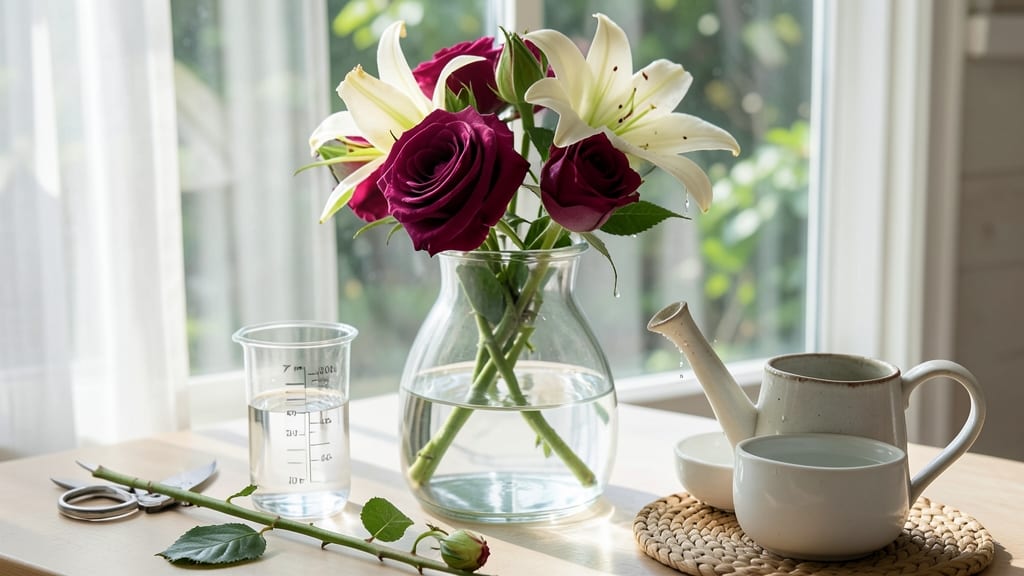
To keep your cut flowers 🌸 fresh for a full week or more, the amount of water in the vase matters more than you think—it’s not just about filling it up.
Struggling to keep your cut flowers fresh longer? The secret isn’t just in the water you add—it’s in the precise ratio you start with. Too much or too little can shorten bloom life by days, even weeks.
Most people guess, but the right water level depends on the type of flowers, vase size, and even the season. Roses need more than tulips, and a tall, narrow vase holds water differently than a wide bowl.
Below, I’ll break down the exact water-to-flower ratio for roses, lilies, and mixed bouquets, plus how to adjust for humidity, temperature, and signs your arrangement is thirsty or drowning. No more wasted blooms!
💧
Frequency
Every 2-3 days
🥛
Amount
1-2 cups (250-500ml)
🌅
Best Time
Morning or Evening
📊
Difficulty
Easy
The perfect water-to-flower ratio for different bloom types
Finding the right water-to-flower ratio can extend your bouquet’s life by 3-7 days. Every flower type absorbs water differently—roses need more hydration than tulips, while lilies require precise levels to prevent bacterial growth.
The key lies in balancing stem thickness, vase diameter, and water volume to avoid air pockets that block absorption.
For example, a single-stem rose in a small vase (6-inch diameter) needs just 1 cup (240ml) of water, while a full bouquet of 15 stems in a large vase (12-inch diameter) demands 3-4 cups (700-950ml).
Overfilling can drown delicate stems, while underfilling leaves them thirsty. Let’s break down the science-backed ratios for your favorite blooms.
Here’s how stem length affects absorption: Longer stems (12+ inches) draw water faster, requiring deeper vases to submerge 2-3 inches of stem. Shorter stems (under 6 inches) need shallower water to avoid bending.
The ideal vase height is 1.5x the stem length—this ensures proper hydration without risking stem rot.
🌸 Pro Tip: Always trim stems at a 45-degree angle before placing them in water. This increases surface area for absorption, letting flowers drink up to 20% more efficiently.
| Flower Type |
Stem Count |
Vase Size (Diameter) |
Water Volume (Cups) |
Stem Submersion Depth |
Notes |
| Roses |
1-3 stems |
6-8 inches |
1-2 cups (240-480ml) |
2-3 inches |
High water needs; add flower food |
| Lilies |
3-5 stems |
8-10 inches |
2-3 cups (480-720ml) |
1.5-2 inches |
Sensitive to bacteria; change water every 2 days |
| Tulips |
5-10 stems |
10-12 inches |
3-4 cups (720-960ml) |
1-1.5 inches |
Low water needs; risk of overhydration |
| Mixed Bouquet |
10-15 stems |
12+ inches |
4-5 cups (960-1200ml) |
2 inches |
How to adjust water levels for longer-lasting arrangements
Adjusting water levels in your vase isn’t just about filling it—it’s about creating the perfect balance for your flowers’ needs. Humidity levels, seasonal changes, and even flower age all play a role in how much water your arrangement should hold.
For example, summer heat means flowers drink faster, while winter air can dry them out quicker than you’d expect.
Start by understanding your flowers’ thirst. Heavy blooms like roses or hydrangeas need deeper water to support their weight, while lightweight stems like baby’s breath or snapdragons can thrive in shallower levels.
The key is to recalibrate water volume based on these factors without drowning the stems or leaving them parched.
1
Check Humidity Levels
Use a hygrometer to measure room humidity. Below 40%? Increase water volume by 20% to compensate for dry air.
2
Seasonal Adjustments
Summer: Fill vase to 3/4 capacity (flowers drink 30% faster). Winter: Reduce to 1/2 capacity (cooler air slows absorption).
3
Flower Age Matters
Fresh cuts (Day 1-3): Use 1 cup (240ml) per 6-inch stem. Day 4+: Increase by 50% to prevent dehydration.
4
Add Preservatives Safely
Mix 1 tsp sugar + 2 drops bleach per quart of water. Never exceed 1/4 tsp bleach—too much damages petals.
Don’t forget to clean your vase before refilling—bacteria from old water can clog stems faster than you think. I like to use a 1:10 vinegar-water solution to sanitize between arrangements. This small step can add 2-3 extra days to your flowers’ life.
For mixed bouquets, prioritize the thirstiest flowers. Place roses or lilies in the center where they’ll have direct access to water, while delicate stems like orchids can sit on the outer edges. This strategic placement ensures even hydration without overcrowding.
Finally, monitor your arrangement daily. If leaves turn yellow or stems droop by midday, it’s time to top off the water. Pro tip: Use a clear vase so you can easily see the water level—no more guessing games!
★★★★★4.6(8 reviews)